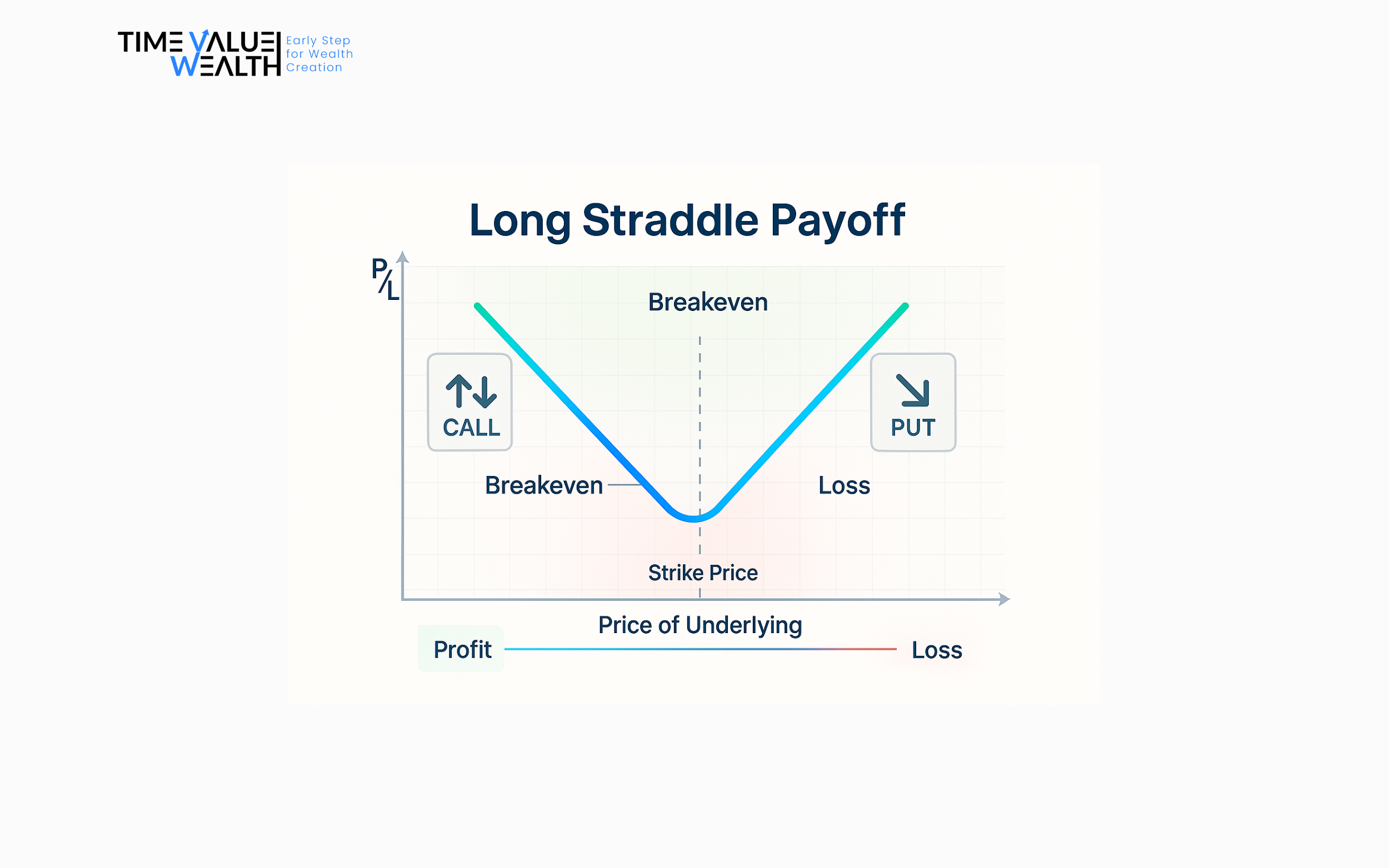
What is a Long Straddle?
A Long Straddle is an options strategy that involves buying both a Call and a Put option with the same strike price and expiry. This strategy profits when the underlying asset makes a large move in either direction — up or down.
Goal: To capitalize on volatility while remaining direction-neutral.
Best For: Traders expecting sharp price swings but unsure of the direction.
Why Use It?
The Long Straddle is useful when you’re confident a stock or index will move significantly, but don’t want to bet on the direction.
- Earnings announcements or major corporate news
- Budget days, policy decisions, macro events
- Technical breakout setups (without directional confirmation)
Educational Insight: Options are cheaper when implied volatility is low. Buying during low IV increases the probability of profit if IV spikes later.
Real Example & Payoff
Example Setup:
Stock = ₹100
Buy ₹100 Call = ₹6
Buy ₹100 Put = ₹5
Total Premium Paid = ₹11 (Max Risk)
Break-even Points:
Upside: ₹111
Downside: ₹89
The payoff structure resembles a “V” — losses capped to premium paid, but unlimited profit potential if the price shoots up or down. If the stock closes between ₹89–₹111 at expiry, you incur a loss.
How to Set Up a Long Straddle
- Buy At-The-Money (ATM) Call Option
- Buy ATM Put Option with the same strike & expiry
- Your total premium outflow is your maximum loss
- Profits are theoretically unlimited if the stock moves far enough
Educational Insight: This setup works best when executed close to the event trigger with minimal delay.
Understanding Greeks: IV & Time Decay
Implied Volatility (IV): A rise after entering increases option prices and can result in early profits — even if the price hasn’t moved much.
Theta (Time Decay): The value of both options erodes as expiry nears. If the underlying doesn’t move, you’ll lose premium daily.
Pro Tip: Monitor Vega (sensitivity to IV) and Theta (time decay) daily when in a straddle position.
Smart Tips for Traders
- Enter when IV is low — gives you cheaper entry
- Use it when markets are calm but news is expected
- Exit early if price moves strongly before expiry
- Avoid holding through expiry if position hasn’t moved
Risk Management Tip: Use alerts and monitor break-even points. If no move occurs early, consider closing to minimize Theta losses.
Pros vs Cons
✅ Pros
- Limited and known risk (just the premium)
- Unlimited upside with significant movement
- Great tool for volatility trades
- No need to predict direction
❌ Cons
- Loss if price stays near strike
- Time decay eats up option value
- Requires precision in timing the entry
Final Word
The Long Straddle is an essential tool in any trader’s strategy playbook. It’s simple to set up, neutral in direction, and perfect for volatility-driven moves. But like all options strategies, success lies in timing, entry, and knowing your exit.
Summary: The Long Straddle is ideal when big news is coming, but you don’t want to guess up or down. It’s low-risk, high-reward — if used with discipline and timing.